Two Birds
- 4.2
- Rating
- 100.00K
- Installs
- Free
- Price
 Analysis by App-foxy
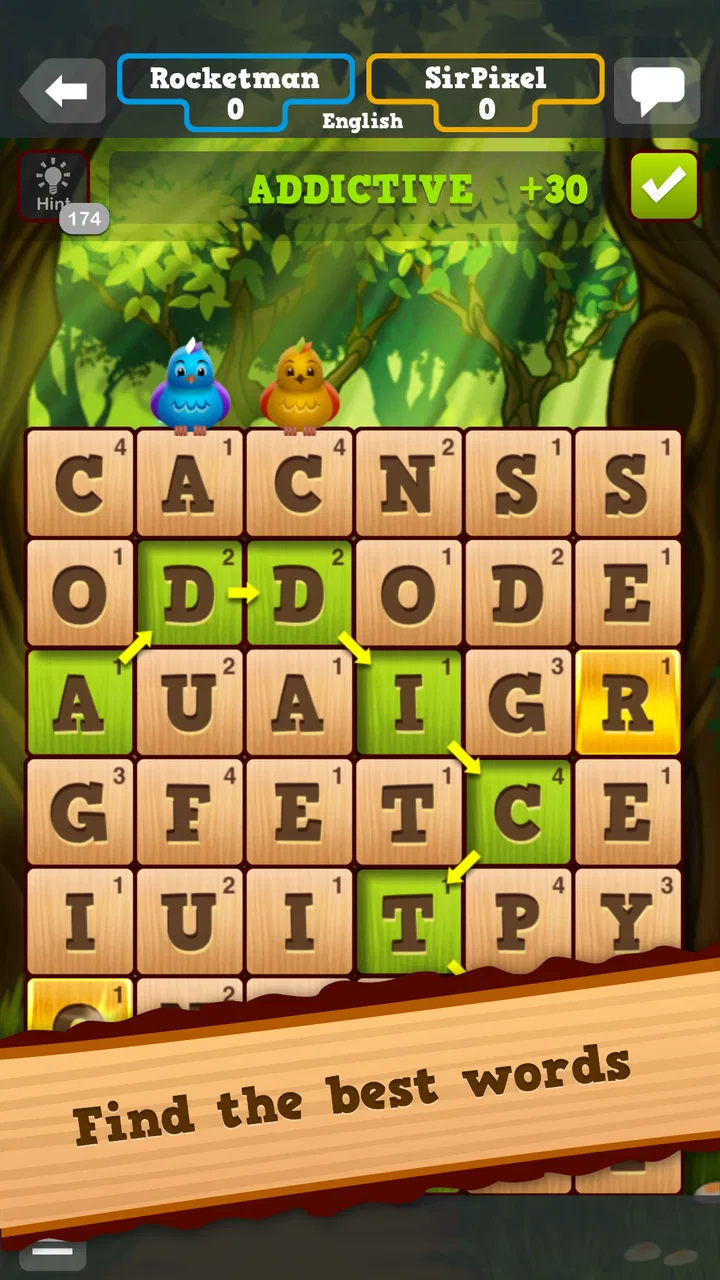
Two Birds is the kind of multiplayer word game that is easy to understand before it becomes difficult to master. I found the appeal almost immediately: each round asks me to think about letters, but the result depends on more than simply knowing long words. Timing, risk, and a little luck all affect the outcome, so a strong vocabulary helps without making every match feel predetermined. That balance is the reason I can imagine returning to it after the first burst of curiosity fades.
Developed by Raketspel, the game sits in the word category and is free to start. It is rated for Everyone, which makes it suitable for casual family play as well as quick matches between friends. The store’s short description is simply “Two Birds,” while the fuller presentation points toward a competitive experience built around skill, luck, and strategy. That combination is a better guide to the actual appeal than treating it as a conventional spelling exercise.
I would not describe it as a replacement for every word-game alternative. Someone looking for a quiet solo puzzle, a large campaign, or a purely educational vocabulary tool may prefer something else. Two Birds makes more sense when the social contest is part of the attraction and when you enjoy the small tension of deciding whether a promising move is worth the risk.
You May Also Like

 Blood Strike: 2.5 Anniversary
Blood Strike’s Loadouts Turn Every Drop Into a Tactical Gamble
A close look at Blood Strike’s custom loadouts: how fast access to signature weapons reshapes its battle royale rhythm, rewards preparation, and narrows the gap between fights.

 Pandora - Music & Podcasts
Pandora’s Music Is Easy to Start, but Harder to Recover
Pandora’s strength is its low-effort path from a seed to a station. Its weak spot is how much confidence it asks you to place in connection, setup, and quiet recovery.

 8 Ball Pool
 Is Built on Rivalries, Rematches, and Routine
A close look at the rivalries, rematches, shared routines, and unanswered safety questions that turn a quick pool match into a persistent mobile community.

 Samsung Music
’s Quiet Strength Is Playing What You Already Own
Its reach comes less from spectacle than from dependable access to a personal library. That simplicity is both the app’s strongest retention engine and its ceiling.

 AccuWeather: Weather Radar
AccuWeather Review: A Quick, Clear Forecast for Everyday Decisions
For everyday plans, the best forecast is the one you can understand quickly. AccuWeather makes rain timing, radar, and local conditions easy to act on, with a few trade-offs.

 Hill Climb Racing
Why Hill Climb Racing Still Turns Crashes Into One More Run
A tiny car, a bumpy hill and one more upgrade: Hill Climb Racing keeps resurfacing because its simple chaos makes every near-miss feel personal.
More From Our News Desk
View All News


Why the first week feels so inviting
During the first week, the strongest quality is the low barrier to entry. I do not need to learn a complicated rulebook before understanding what I am trying to do. The word-game foundation is familiar enough that a new player can begin making decisions quickly, yet the multiplayer setting gives ordinary letters more pressure than they would have in a solo puzzle.
That pressure changes the way I look at a board. In a typical word search, I am mainly asking whether a word exists. Here, I am also considering whether using it now is sensible, whether a safer move would protect my position, and whether the available opportunity is worth leaving behind. Even when the game presents a modest choice, the competitive context makes it feel meaningful.
The mixture of skill and luck is important. If every result depended entirely on vocabulary, experienced players could make newcomers feel irrelevant. If luck dominated, careful play would not matter much. Two Birds works best in the middle: I can improve my decisions, but I still have to react to circumstances I cannot fully control. That makes a close match feel less like a test I have already failed and more like a contest I can still influence.
A realistic use case is a short break during the day. I can imagine opening it while waiting for a friend, playing a round with someone I know, and putting it away without needing a long uninterrupted session. The format suits people who enjoy conversation around a game rather than disappearing into a large, demanding world. It also gives friends a reason to return to the same activity without arranging a full evening around it.
My first practical tip is to avoid treating every attractive word as an automatic play. In a competitive word game, the most impressive-looking option is not always the most useful one. I get more value from pausing briefly to consider what the move gives me, what it leaves available, and how much of the result depends on favorable luck. That small habit separates casual guessing from deliberate play.
The game’s rating of 4.2 from around 2.2 thousand ratings suggests that many players find the central idea enjoyable, while also leaving room for individual preferences. I think that fits the experience: the basic loop is approachable, but its appeal depends heavily on whether I enjoy asynchronous-feeling competition, repeated word decisions, and the emotional swing between a clever move and an unlucky turn.
Learning the rhythm rather than memorizing rules
What I would focus on during the opening sessions is not building a huge vocabulary list. I would watch the rhythm of a match instead. Notice when patience pays off, when a conservative choice keeps the game alive, and when a bold move is justified because the situation is already unfavorable. This approach makes the game more interesting than simply searching for the longest possible word.
It also helps new players avoid a common frustration. A loss does not necessarily mean that the opponent knew more words. Sometimes the difference comes from choosing better moments to take chances. Once I view the game that way, I can learn from a result even when the luck element does not go my way.
That said, the first-week appeal can be stronger for players who already like word competitions. If I prefer completely predictable puzzles, the random element may feel irritating rather than exciting. Likewise, if I dislike playing against other people, the main source of tension becomes a drawback instead of a benefit.
What remains useful from month to month
The long-term question is whether the core decisions stay interesting after the novelty disappears. In my view, Two Birds has a reasonable chance of earning recurring play because its value comes from judgment, not only discovery. Once I understand the basic idea, I can still improve at reading situations, managing risk, and recognizing when a modest move is strategically better than a flashy one.
This is where the multiplayer design matters most. A solo puzzle is often measured against a fixed solution or a personal best. A match gives me a changing human target. Different opponents create different pressures: one may play aggressively, another may protect a lead, and another may make unusual choices that force me to rethink my assumptions. That variety can extend the life of a simple ruleset.
For regular use, I would build a small routine around it rather than opening it every time I have a spare second. A few deliberate matches are more likely to remain enjoyable than turning every idle moment into another round. The game benefits from being a compact social habit, not from becoming an obligation. If I play while distracted, losses can feel arbitrary and wins less satisfying.
One useful long-term technique is to review the decision immediately after a match. I would ask myself whether I lost because of an unlucky outcome or because I committed too early, ignored a safer option, or failed to protect a lead. That simple distinction prevents me from blaming luck for every poor result. It also turns repeated play into actual improvement instead of repetition without learning.
The game has been available since March 4, 2015, and its current version is 2.4.1. Those details matter less as selling points than as context: this is not a brand-new experiment that needs novelty alone to attract attention. Its longevity gives the concept a chance to stand on its own, although lasting value still depends on whether I enjoy the particular style of competition.
With more than 100 thousand installs, it has found an audience large enough to make the concept feel established rather than obscure. I would still judge it by my own preferred rhythm. A broad player base does not guarantee that every match will suit me, but it does make the game easier to recommend to someone who wants a word challenge with a social angle.
Who gets the most from repeated play
I think the best long-term audience is made up of players who enjoy small improvements. This is not necessarily for someone chasing a dramatic progression system. It is better for the person who likes noticing that they now manage risky positions more calmly, recognize useful opportunities faster, or stop wasting good options just because they look impressive.
It can also work well between friends who enjoy friendly rivalry. A recurring match gives the game a personal history, and that history can matter more than any single result. If both players have similar expectations about taking turns and accepting occasional luck, the contest can become a pleasant ritual rather than a source of arguments.
I would be more cautious recommending it to a person who wants a rich solo experience. The word category includes many alternatives built around daily puzzles, timed challenges, anagrams, or expansive vocabulary practice. Those options may be better when the goal is quiet concentration or measurable personal progress. Two Birds earns its place through interaction and tactical uncertainty, not through a large collection of solitary activities.
Maintenance, friction, and the cost of keeping it installed
Because the game is free, the initial barrier is low. That makes it easy to try without deciding whether the experience deserves a purchase first. The trade-off is that in-app purchases range from $0.99 to $65.50 per item. I would keep that in mind before allowing the game to become a frequent habit, especially if I am the sort of player who spends impulsively after a frustrating match.
The free starting point is useful for testing the central loop, but I would not assume that every player will have the same relationship with optional spending. My advice is simple: decide in advance whether I am treating the game as a no-cost pastime or as something I may financially support. That boundary is easier to maintain before a close loss creates the temptation to buy a shortcut or another opportunity.
There is also a maintenance burden that has nothing to do with money. Multiplayer games need a reliable social rhythm. If I start matches with people who rarely return, the experience can feel inactive even if the underlying word play remains good. The best way to preserve its value is to play with opponents who actually enjoy coming back, rather than collecting unfinished contests.
That makes the game less suitable for someone who wants instant, self-contained entertainment every time. A solo puzzle is always ready on its own terms. Two Birds is more rewarding when the surrounding habit works: opponents respond, the pace feels comfortable, and I am willing to accept that a competitive match may not deliver immediate closure.
The minimum operating requirement is Android 7.0, and the game is also available in the broader Android and iOS app context represented by this catalog. For a person using an older Android device, checking compatibility before planning regular play is sensible. For most readers with a reasonably current phone, the more important question is not technical access but whether the multiplayer format fits their routine.
Raketspel’s compact design also means I would not install it expecting a broad all-purpose word-learning environment. It is a focused game. That focus is a strength when I want a quick contest, but it becomes a limitation if I need definitions, lessons, writing practice, or a structured educational path. Those are different jobs, and another app will usually handle them better.
Where fatigue begins after the novelty
The first source of fatigue is repetition. Even a good word-game loop can lose energy if every session starts to feel identical. Two Birds depends on the quality of the decisions inside its matches, so players who need constant new modes, stories, or visual rewards may eventually feel that the framework is too narrow.
The second is the luck component. I appreciate uncertainty when it creates suspense, but I do not enjoy it when I feel that careful play has been erased by circumstances outside my control. The right attitude is to judge decisions over many matches rather than one result. If I cannot accept that mindset, the game may become more aggravating than entertaining.
Another possible problem is the difference in experience between opponents. A newcomer facing someone who has developed strong instincts may struggle to understand why a match went badly. The game is more welcoming when players treat early losses as practice, but not everyone enjoys learning through repeated defeat. I would recommend starting with patient friends rather than immediately seeking the toughest competition.
There is also a social fatigue that can appear in any multiplayer word game. If I feel obliged to reply quickly, maintain several matches, or keep playing simply because someone is waiting, a relaxing pastime can turn into another notification demanding attention. I would protect its long-term value by limiting the number of active games and choosing times when I actually want to think.
Spending can add another layer of fatigue. The wide range of in-app purchase prices means I would pay attention to how optional purchases affect my sense of fairness and control. Even when I never buy anything, the presence of paid items can change how I evaluate a free game. For me, the experience remains worthwhile only if the basic contest is enjoyable without feeling pressured to spend.
These limitations do not cancel the strengths, but they define the audience. Two Birds is not the right choice for a player who wants a completely calm puzzle, a guaranteed equal skill level, or a large stream of fresh content. It is a better fit for someone who enjoys making imperfect decisions under pressure and can regard an unlucky result as part of the match rather than a personal failure.
How it compares with familiar word-game alternatives
Compared with a daily word puzzle, this game feels more social and less self-contained. A daily puzzle gives me a fixed challenge that I can solve at my own pace, while Two Birds asks me to think about another player’s position and the consequences of my timing. I would choose the daily format when I want a private ritual and choose this one when competition is the point.
Compared with a crossword or anagram trainer, it offers less emphasis on careful clue solving or systematic vocabulary practice. Those alternatives can be better for learning new words, improving recall, or filling a quiet stretch of time without interpersonal pressure. Two Birds is more appealing when the word itself is only part of the decision.
Compared with a fast arcade word game, it has a more thoughtful identity. I do not approach it only as a test of speed. The useful skill is knowing when to act and when not to overreach. Players who want frantic timers may find it too measured, while players who like tactical pauses may appreciate that difference.
That comparison also explains why I would not recommend replacing every other word app with it. Its strength is specialization. It gives me a competitive word experience with a blend of ability and chance, but it does not need to become a dictionary, lesson plan, daily journal, and party game at the same time.
My long-term verdict
After the initial novelty, Two Birds earns lasting space only when I use it intentionally. Its strongest qualities are the approachable word-game structure, the human unpredictability of multiplayer play, and the satisfying tension between skill and luck. Those qualities are specific enough to support a recurring habit, especially when I have a regular opponent and enjoy improving through small strategic adjustments.
I would recommend it to a friend who likes word challenges but wants more interaction than a solo puzzle provides. It is also a good match for casual players who want a free starting point, a Everyone age rating, and a game that can fit into short breaks. The free entry makes experimentation easy, while the competitive design gives the experience more staying power than a one-time novelty.
I would skip it if my priority is a deep solo campaign, formal vocabulary instruction, instant rounds with no waiting, or a completely luck-free test of knowledge. I would also be careful if optional purchases tend to turn casual games into expensive habits. In those situations, a daily puzzle, crossword app, or dedicated learning tool may serve me better.
My final advice is to judge the game after several thoughtful matches, not after one lucky win or frustrating loss. Try to play with someone who enjoys the same pace, keep the spending boundary clear, and pay attention to decisions rather than only outcomes. If that style of play feels rewarding, the game can remain a compact and genuinely replayable part of a weekly routine. If it feels like waiting, guessing, or repeating the same contest without learning, the novelty will probably fade quickly.
Overall, I see Two Birds as a focused word competition rather than a universal puzzle recommendation. Its lasting value comes from the choices made between letters, the personality of the opponent, and the willingness to accept uncertainty. For me, that is enough to keep it installed—but only as a deliberate social game, not as an app I would open automatically every day.
FAQs for Two Birds
01What is Two Birds, and how does the app work?
Two Birds is an app designed around connecting users through shared activities, conversations, or interests, depending on the version available in your region. After installing it, you typically create a profile, review the available options, and interact with other users or content through the main interface. The exact features may vary by platform, account type, and location, so it is worth checking the app description before registering.
02Is Two Birds free to download and use?
Two Birds can generally be downloaded without an upfront charge, but some features may require in-app purchases, a subscription, or additional payments. Before confirming any purchase, review the pricing information shown in the App Store or Google Play and check whether the subscription renews automatically. Free access may also include limitations, advertisements, or restricted communication and personalization options.
03Does Two Birds require an account or personal information?
Most of the app’s useful functions may require you to create an account. Depending on the platform, registration can involve an email address, phone number, name, profile photo, location, or other optional details. Before signing up, read the privacy policy and permission requests carefully. Avoid sharing sensitive information publicly, and use the app’s privacy and visibility controls whenever they are available.
04Is Two Birds safe for meeting or interacting with other users?
As with any app involving communication or user-generated profiles, safety depends on both the platform’s tools and your own decisions. Use reporting and blocking features for suspicious behavior, avoid sending money or private documents, and be cautious if someone pressures you to move conversations elsewhere. If you arrange an in-person meeting, choose a public location and tell a trusted person about your plans.
05What devices are compatible with Two Birds, and what should I check before downloading?
Two Birds may be available for Android, iPhone, or both, but compatibility can depend on your operating system version and device hardware. Check the official Google Play or App Store listing for the current requirements, developer information, latest update date, and user reviews. Confirm that you have enough storage and a reliable internet connection, since some features may not work fully offline.
Pros
- Simple gameplay that is easy to understand within a few minutes.
- Short rounds make it suitable for quick breaks or casual sessions.
- Charming bird theme gives the game a light
- friendly atmosphere.
- Progression encourages repeated play without requiring long sessions.
- Works well for players looking for a relaxing
- low-pressure experience.
Cons
- Gameplay may feel repetitive after extended play.
- Limited depth may disappoint experienced puzzle or strategy players.
- Difficulty balance can make some stages feel uneven.
- Progress may become slower without optional purchases or extra effort.
- Replay value depends heavily on personal interest in its simple mechanics.

Two Birds
Gallery